
Affordable Housing is defined as homeownership and rental housing for low to moderate income households costing less than 30% of their gross income. Access to affordable housing is fundamental to physical, economic and social well being.
The Affordable Housing Continuum
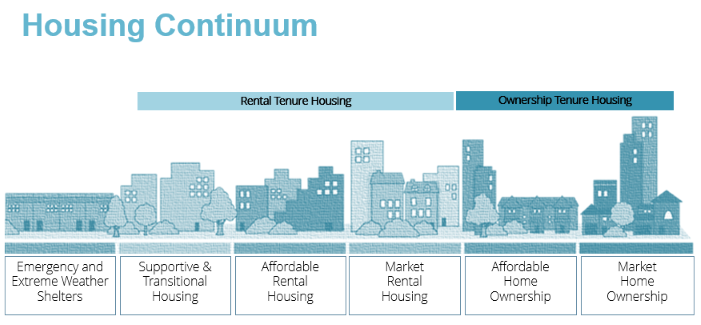
The Affordable Housing Continuum represents the spectrum of housing types available to low and moderate-income households. Six population groups have been identified as priority groups particularly affected by housing issues in the City.
The City's Role
Ensuring residents have access to a variety of housing choices that are affordable requires the participation of many groups: all levels of government, service agencies, and the non-profit and private sectors. The City plays an important role in the following ways:
- Setting Policy -- Clear, consistently applied policies express the City's commitment to affordable/attainable housing.
- Establishing Regulations -- Effective use of regulatory authority on attainable homeownership and rental housing creates housing choice for residents.
- Using Resources -- Strategic use of City resources can leverage an increased supply of affordable/ attainable housing.
- Entering into Partnerships -- Collaboration with the business and non-profit communities and Provincial agencies will lead to creative solutions to existing and emerging housing issues.
- Advocating -- A commitment to ongoing leadership on housing.
- Promoting Quality Design and Innovation -- Focus on sustainable, energy conserving, and attractive design and development of new and conventional housing forms that will reduce maintenance costs and increase neighbourhood acceptability.
Affordable Housing Strategy
In 2010, the City of New Westminster completed an Affordable Housing Strategy as an update to the Housing Strategy that had been implemented 13 years earlier.
This Strategy will enable the City to develop policies and tools that will promote housing affordability to meet the full range of incomes and needs in the City. The Strategy focuses primarily on permanent housing, placing a greater emphasis on the City of New Westminster's role as a facilitator in the development of affordable housing through the private market.
Inclusionary Housing Policy
The Inclusionary Housing Policy (2025) set the expectation that applicable multiple unit residential or mixed-use development applications which are seeking increases in development entitlements will make a contribution towards below market housing units in New Westminster. The Policy was updated by Council on September 8, 2025 and replaces the previous Inclusionary Housing Policy (2019).
This Policy applies city-wide to development application which provide 10 or more residential units and includes the following key requirements:
| Number of Inclusionary Units | 10% of the total number of residential units in a development application |
| Maximum rents | Not more than 10% below CMHC average rents |
| Inclusionary Unit Ownership | Sold to qualified non-profit operators at a subsidized price |
Other provisions, not-for-profit operator selection, purchase price methodology, tenant eligibility, unit design and location, and the length of affordability requirements are outlined in the policy.
Some development applications would be exempt from the policy, including those:
- which do not include any residential units;
- which include 10 or fewer units;
- are located in Queensborough;
- in which all of the units are townhouses;
- in which all of the units are secured market rental housing; and
- which are affordable housing projects.
Key financial parameters related to the Policy including maximum inclusionary housing units rents, below market sales prices for inclusionary housing units and cash-in-lieu charges are in included in the Inclusionary Housing Policy Financial Parameters (2025).