Image
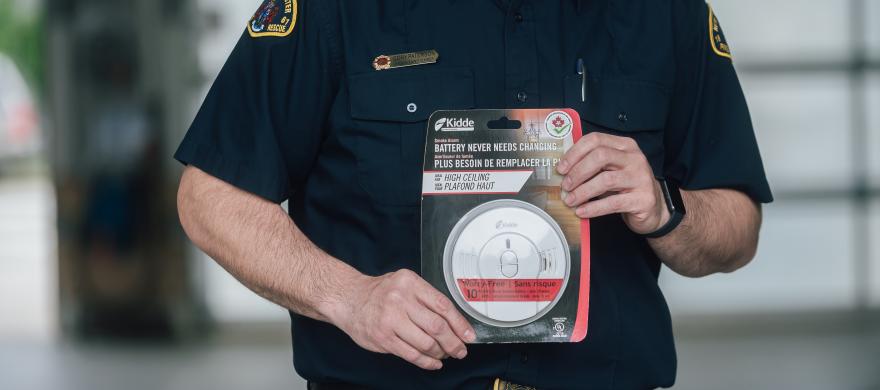

Please be advised of the following bulletins & guidelines:
A parking garage is classified as a storage garage per the BC Building Code. A storage garage, by definition, is designed for the storage or parking of motor vehicles. As a subsidiary use, a parking garage may contain space for parking or storing other vehicles, such as bicycles, boats, mobility aids, electric bicycles, etc. All vehicles are required to be parked in a manner that does not obstruct or impede egress routes.
Vehicles and trailers that are being stored in a parking garage are prohibited from being used for material storage.
Use of the area for any purpose other than the original design shall not be carried out in a building. All combustible materials, other than those inherently a part of a vehicle, is not permitted to be stored in a parking garage that serves only one dwelling unit. Management of the parking garage is the responsibility of the building owner(s).
A fire incident inside of a parking garage is inherently dangerous for firefighters; the added fuel load from unexpected storage of items of items increases the hazards firefighters may have to deal with in the event of an emergency. Please take the time to store items in the approved locations.
Additional limitations may be applicable depending on the nature of the building. Please consult with strata bylaws, rental contracts, insurance policies and other agreements that may be applicable. Violation of an applicable regulation or agreement may result in fees, fines or other consequences.
For a strata building, the Strata Property Act states that the strata council’s role is to “exercise the powers and perform the duties of the strata corporation, including the enforcement of bylaws and rules”. Information on enforcing strata bylaws and rules is available on the Government of BC website. Visit 2.gov.bc.ca and search ‘enforcing strata bylaws’ to learn more.
For a rental building, the landlord may specify the rules and conditions regarding how the parking garage can be used. Please review the rental contract for details.
Property Management Company or Strata may take enforcement measures including warnings, fees, fines, etc. for any rental contract or strata bylaw violations
Outdoor gas appliances including fire pits, portable heaters and decorative fire tables, have gained popularity in our community due to their ease of use, affordability and the fact that they are readily available at local suppliers.
The CNW Fire Protection Bylaw does not currently permit the use of such appliances, which are not solely used for the cooking and preparation of food. The bylaw is currently under review for amendment to reflect our support for the safe use of outdoor gas appliances. In preparation, New Westminster Fire and Rescue Services (NWFRS) reviewed the current regulations, conducted a survey of surrounding municipalities, and reviewed burning complaints in New Westminster to identify considerations to be addressed.
Given the ease of accessibility, the desire of residents to use clean fuel outdoor appliances and the fact that there is no data supporting an increase in fire damage due to these appliances, NWFRS will allow the use of fire pits, portable heaters and decorative fire tables provided that the following criteria are met:
*Please visit the Technical Safety BC website for a full list of certification body approval marks.
**In the case of Strata property, it is the responsibility of each individual to confirm Strata rules and regulations approve the use of these devices prior to use.
When using any such device, residents are required to take reasonable precautions to ensure the fire is contained and turn the unit off when not attended. Please take extra precautions when operating with young children and pets in proximity.
“Compulsive hoarding (aka pathological hoarding) is acquiring possessions along with the failure to discard them, even if the items are worthless, or no longer useful. Hoarding items fill the person’s home, and can cause severe problems with day-to-day activities and relationships, and also pose a danger to life through fire and health safety hazards.” [eMentalHealth Services and Resources]
For information on enforcing strata bylaws and rules, visit the Government of BC website and search “enforcing strata bylaws and rules”.
Do you have permission to set off fireworks?
Consent is required from the property owner for fireworks intended for personal use and a City permit is required for high hazard fireworks.
Do you know where to set off fireworks?
Fireworks can be set off on private property, by an adult, with consent from the property owner.
Do you know when you can possess fireworks?
Fireworks can be possessed between October 28 and October 31.
Do you know when you can set off fireworks?
Fireworks may be set off in the late afternoon and evening of October 31.
Do you know how to safely operate fireworks?
In every instance, if the fire alarm sounds, all building staff and occupants should respond as though it is a real emergency. Refer to your building’s Fire Safety Plan for emergency procedures, which should be readily accessible to all property owners/owner’s agents. Fire alarm systems perform the crucial function of alerting occupants to a possible fire in the building. While false alarms can occur, it is essential to treat every alarm seriously and investigate the situation to determine if there is an emergency.
New Westminster Fire and Rescue Services (NWFRS) advises that silencing or resetting alarms should be done only after the fire department has arrived and assessed the situation.
Most fire alarm systems have a silencing or acknowledging (“ACK”) feature. Activating this feature will disable the audiable alarms, and they will NOT automatically re-initiate in an actual fire situation. They may only be re-initiated manually in most newer alarm systems. Premature silencing or acknowledging of alarm systems has resulted in fire-related fatalities. Due to this risk, you are reminded that liability could arise in any emergency where premature silencing or acknowledging leads to injury or death.
Resetting fire alarm systems will return it to normal operating status. In the event of an ongoing fire, the system will detect and sound the alarm again. In the case of a false alarm, resetting the system will silence the audible signal and return the panel to normal status. Important alarm panel information, such as the location of the issue, may be lost if it is not recorded before resetting. A faulty device responsible for a false alarm may not be located if the system has been reset. Continued operation of a faulty fire alarm system may generate subsequent false alarms. Excessive false alarms will result in fees charged to the building owner or occupant. Please refer to our Fire Protection Bylaw No. 6940, 2004 for the fee schedule.
NWFRS request that you do not reset the alarm system until after fire personnel have arrived. This will allow them to work with you to identify the location of the problem. Resetting a system before NWFRS arrives may delay and prolong firefighters’ response. This can result in them being out of service and unable to respond to other emergencies for longer than necessary.
Intent: To provide information for, and verification from, all vendors and event organizers, in regards to fire and life safety protocols at each booth, during an event.
Check all that apply:
**Fire inspectors will be on site during set up. Any booth found to be in contravention with the safety measures outlined above or with the Fire Protection Bylaw may be prevented from operating until safety measures are in place or prohibited from participating in the day’s event.**
Community Vendor Fire Safety Declaration - Signature Required (PDF)
Purpose: The following information is compiled to assist the homeowner in developing an acceptable standard of fire safety within a home-based Bed and Breakfast (B&B) in the City of New Westminster. As a B&B business owner, ensuring the safety of your guests is both a legal obligation and a top priority. Because B&B guests are often unfamiliar with your home’s layout, life safety codes strictly enforce emergency exit standards. This bulletin outlines the mandatory primary and secondary escape requirements for your property's living and sleeping areas.
Definition: “A Bed & Breakfast is a home-based business that provides temporary sleeping accommodations on not less than a daily basis, including the provision of a daily breakfast.”
Every B&B owner shall develop a fire safety plan, review it annually, and update it as necessary. The emergency escape plan should be developed for effectiveness and tested twice a year, along with your personal home escape plan.
The fire safety plan should include:
Emergency Escape Plan – Posted Procedures (see Figure 1):
A Primary Means of Escape is the main route your guests use daily. It must provide a clear, unobstructed path to the outside at ground level via: a standard door, a stairway, or a ramp.
The Secondary Means of Escape is an alternative way out, in the event the primary is blocked by fire. If the guest unit is sprinklered it does not require a secondary means of escape. Options include: a second, primary exit leading directly outside, an approved window *(see specification below), or a passage through an adjacent room, such as a shared sitting area leading to an exit. Note: this space cannot have a lock on the door that could trap a guest.
*Windows as a secondary means of escape - criteria: Using a window is the most common way B&B owners meet the secondary exit requirement. To qualify as a legal emergency exit for your guests, the window must be easily operable and meet at least one of these conditions:
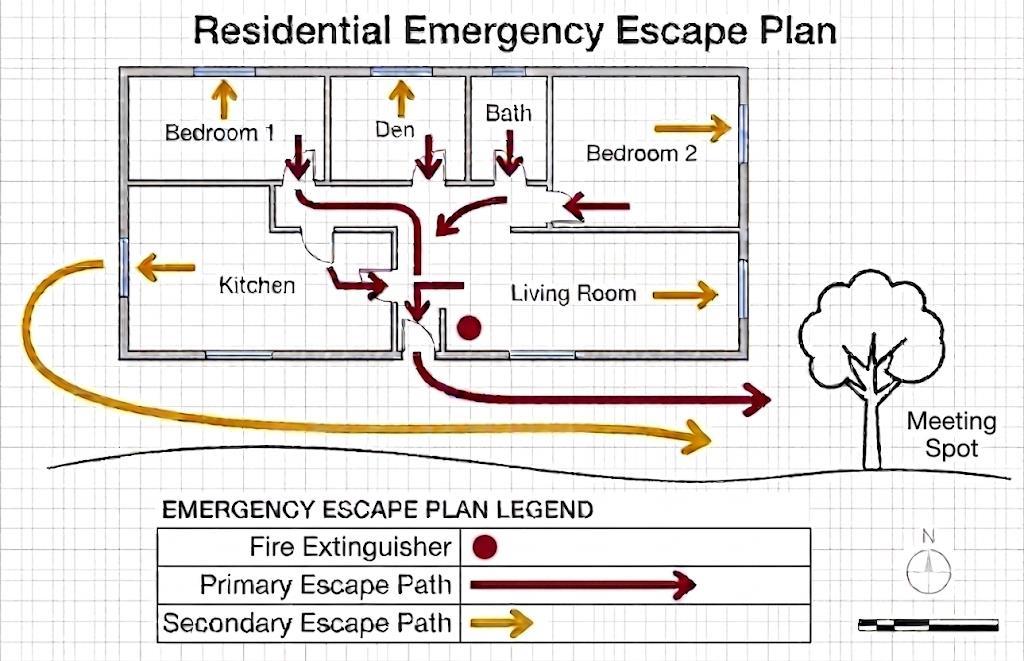
Figure 1 - Sample Escape Plan
The Emergency Escape Plan is to be reviewed with the New Westminster Fire Services PRIOR to posting. Send plan to fire-fpo@newwestcity.ca for review. **Include street address in subject header of email**
2. Fire Protection Equipment
2a) Fire Extinguishers:
2b) Smoke Alarms:
3. Record of Routine Maintenance and Inspection – Fire Protection Equipment:
To be conducted by the property/business owner, or their delegated representative, before and after every guest.
Portable fire extinguishers are useful only if you know how to use them, if they are right for the type of fire you are fighting, and if the fire is discovered immediately.