


Signal Timing on westbound Braid Street
Signals near the Braid Street rail crossings now turn green in sequence to help traffic move safely through the area.
Why has the timing changed?
The signals are coordinated to reduce the likelihood of vehicles stopping on or near the rail tracks. Instead of turning green at the same time, each signal changes in sequence so traffic starts moving from the back then proceeds efficiently through the corridor.
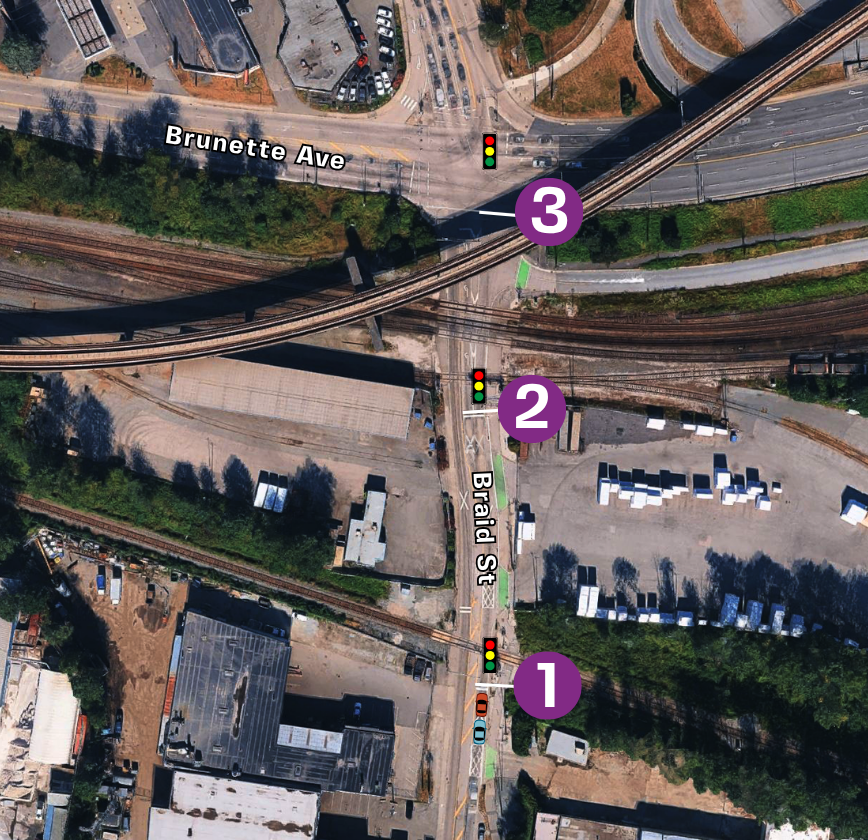
Where do I stop to activate the traffic signals?
Stop at the marked stop line before the first railway crossing signal. A vehicle must be detected at this location to activate the westbound signal sequence up to and through Brunette Avenue.
Remain behind the stop line until Signal 1 turns green. Do not pull forward between the railway crossings while waiting. Because Signal 2 and 3 are delayed, you won’t get there any faster by stopping in the middle.
How do the new signals work?
When a vehicle is stopped at Signal 1, the traffic light sequence is initiated.
Signal 1 turns green first and traffic begins moving. Approximately ten seconds later, Signal 2 turns green, followed ten seconds later by Signal 3. Now traffic is fully flowing through Brunette Avenue.
Then the signals turn red in sequence starting with Signal 1, then 2, then 3. Vehicles should be stopped behind Signal 1 so that no vehicles are at Signal 2 or 3. This increases safety in case of a train approaching.
During a train crossing, make sure to obey the rail safety signals. After the train has crossed, the signals will resume the standard timing.
Make sure you fully stop behind the red light.